
唐韵 TangYun (小篆 XiaoZhuan) Icons 1.0.1
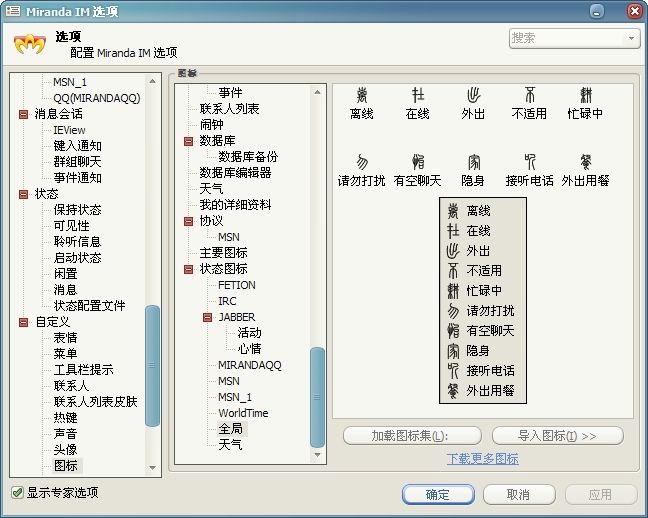
Description: 使用北師大說文小篆生成.
Chinese - English - XiaoZhuan - IM Status Dictionary:
http://lancaster.themex.net/archives/1304
小篆是在秦始皇统一中国后(前221年),推行“书同文,车同轨”,统一度量衡的政策,由宰相李斯负责,在秦国原来使用的大篆籀文的基础上,进行简化,取消其他六国的异体字,创制的统一文字汉字书写形式。一直在中国流行到西汉末年(约公元8年),才逐渐被隶书所取代。但由于其字体优美,始终被书法家所青睐。又因为其笔画复杂,形式奇古,而且可以随意添加曲折,印章刻制上,尤其是需要防伪的官方印章,一直采用篆书,直到封建王朝覆灭,近代新防伪技术出现。现代的康熙字典上所有的字还注有小篆写法。
维基中文: http://zh.wikipedia.org/w/index.php?title=%E5%B0%8F%E7%AF%86&variant=zh-cn
Lesser or Small Seal Script (小篆 Xiaozhuan), or Hsiao-chuan is associated with the work on Chinese characters compiled by Li Si during the Qin Dynasty under the First Emperor of China, Qin Shi Huang.
Before the Qin conquest of the last remaining six of the Seven Warring States of China, local styles of characters eveloved independent of one another for centuries producing what are called the Six States Scripts 六國文字. Under one unified government however, the diversity was not deemed desirable for mainly two reasons; first it hindered timely communication, trade, taxing, and transportation, and second independent scripts represented possibly dissenting political ideas especially in areas where the Confucian tradition remained strong.
Wikipedia EN: http://en.wikipedia.org/wiki/Small_Seal_Script
唐韵 TangYun (楷书 KaiShu) Icons 1.0
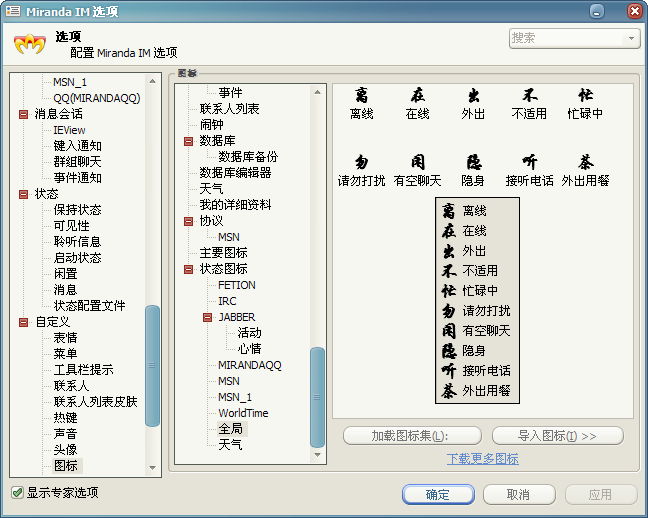
Description: 使用微软简行楷生成.
Chinese - English - KaiShu - IM Status Dictionary:
http://lancaster.themex.net/archives/1288
楷书又称“正书”,或称“真书”,是汉字书法中常见的一种字体。字形较为正方,不像隶书写成扁形。
维基中文: http://zh.wikipedia.org/w/index.php?title=%E6%A5%B7%E4%B9%A6&variant=zh-cn
The regular script or standard script, or in Chinese kaishu (simplified Chinese: 楷书; traditional Chinese: 楷書; pinyin: kǎishū) and Japanese kaisho, also commonly known as standard regular (正楷), is the newest of the Chinese calligraphy styles (appearing by the Cao Wei dynasty ca. 200 CE and maturing stylistically around the 7th century), hence most common in modern writings and publications (after the non-calligraphic printing Song Ti). It is also occasionally known as true script (真書 zhēnshū) and standard script (正書 zhèngshū).
Wikipedia EN: http://en.wikipedia.org/wiki/Regular_script
唐韵 TangYun (章草 ZhangCao) Icons 1.0
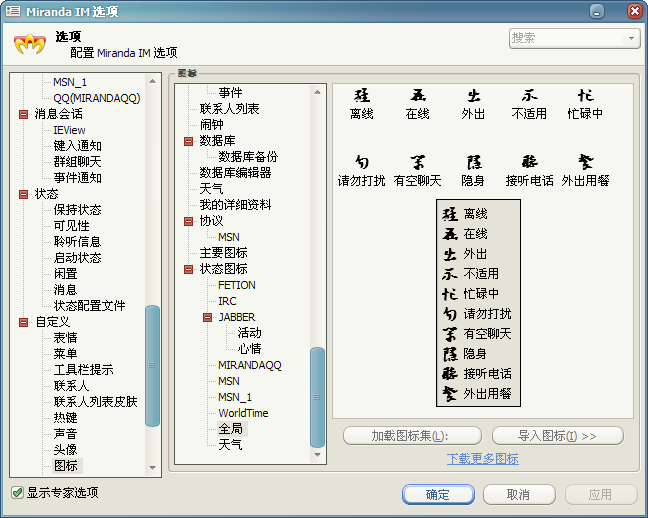
Description: 使用章草生成.
Chinese - English - ZhangCao - IM Status Dictionary:
http://lancaster.themex.net/archives/1300
章草,草书的一种,由隶书直接演变而来,“凡草书分波磔者名章草”[1],起于西汉,成熟于东汉。
章草的起源,按照唐朝张怀瓘主张,“章草者,汉黄门令史游所作也。”“因章帝所好名焉。”[2],认为章草起于史游所做的《急就章》,得名于汉章帝。另有因《急就章》得名和因用于章奏而得名的说法。
著名的章草作品有《平复帖》(陆机)等。
维基中文: http://zh.wikipedia.org/w/index.php?title=%E7%AB%A0%E8%8D%89&variant=zh-cn
唐韵 TangYun (褚楷 ZhuKai) Icons 1.0
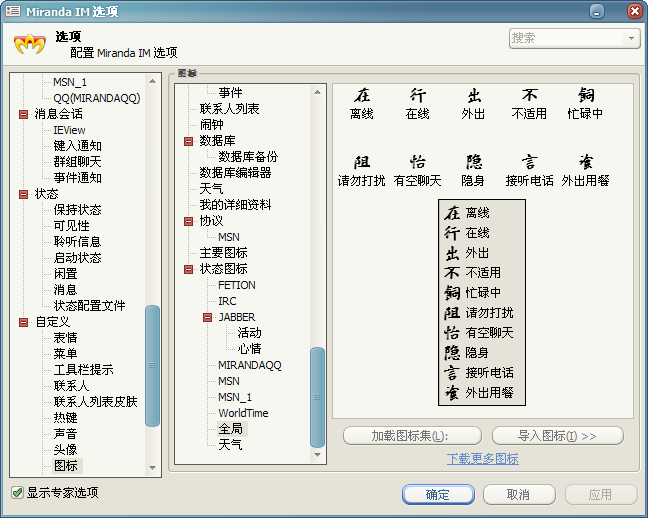
Description: 使用汉仪褚楷繁生成, 非常喜爱的书法家.
Chinese - English - KaiShu - IM Status Dictionary:
http://lancaster.themex.net/archives/1292
褚遂良(596年—658年或659年),字登善,唐朝政治家,书法家。钱塘人(今浙江杭州)。
博学多才,精通文史。隋末时跟随薛举为通事舍人。后在唐朝任谏议大夫,中书令等职。贞观二十三年(649年),与长孙无忌同受太宗遗诏辅政。唐高宗欲立武则天为皇后,褚遂良与长孙无忌坚决反对。武后即位后,遭贬斥而死。
褚工于书法,初学虞世南,后取法王羲之,与欧阳询,虞世南,薛稷并称“初唐四大家”。其特点是善把虞、欧笔法融为一体,方圆兼备,舒展自如。《唐人书评》中把褚遂良的字誉为“字里金生,行间玉润,法则温雅,美丽多方”,宋代大书法家米芾也称颂他为“九奏万舞,鹤鹭充庭,锵玉鸣珰,窈窕合度”。传世的墨迹有《倪宽赞》,大字《阴符经》,他还临摹过王羲之的《兰亭序》。
维基中文: http://zh.wikipedia.org/w/index.php?title=%E8%A4%9A%E9%81%82%E8%89%AF&variant=zh-cn
Chu Suiliang (褚遂良) (597-658), courtesy name Dengshan (登善), formally Duke of Henan (河南公), was a chancellor of the Chinese dynasty Tang Dynasty, during the reigns of Emperor Taizong and Emperor Taizong’s son Emperor Gaozong. He became increasingly trusted by Emperor Taizong toward the end of his reign and was charged with the responsibilities of serving as the imperial historian and providing honest advice. At Emperor Taizong’s death, Chu was entrusted with the responsibilities of assisting Emperor Gaozong, along with Emperor Gaozong’s uncle Zhangsun Wuji. In 655, over his strenuous opposition to Emperor Gaozong’s removal of his first wife Empress Wang and replacing her with Empress Wu (later known as Wu Zetian), Chu was demoted, and that began a series of demotions, eventually to be the prefect of the extremely distant Ai Prefecture (愛州, roughly modern Thanh Hoa Province, Vietnam). He died in exile in 658.
Wikipedia EN: http://en.wikipedia.org/wiki/Chu_Suiliang
唐韵 TangYun (MiFei) Icons 1.0
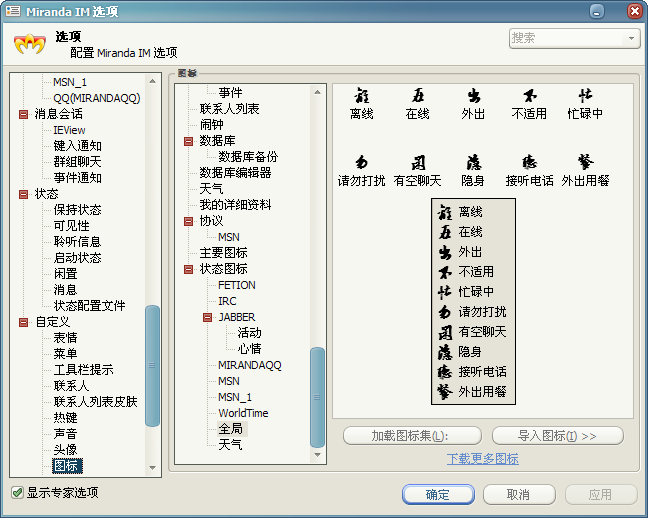
Description: 使用书体坊米芾体生成.
Chinese - English - XingShu - IM Status Dictionary:
http://lancaster.themex.net/archives/1283
米芾[1](1051年-1107年[2]),北宋书画家。初名黻[3],字元章,时人号襄阳漫士、海岳外史,自号鹿门居士。
米芾原籍襄阳(今属湖北),后定居润州(今江苏镇江)。因其衣着行为以及迷恋书画珍石的态度皆被当世视为癫狂,故又有“米颠”之称。米芾于砚,素有研究,宋·何蘧《春渚纪闻》记载宋徽宗召米芾写字,米芾看到皇帝桌上有名砚,米芾一写完字,就抱上砚台跪请曰:“此砚经臣濡染,不可复以进御,取进止。”让皇帝把砚台赐给他,皇帝答应他,便急着把砚台抱回,连衣服都染黑了。《志林》记米芾得一砚山而抱眠三日。著有《砚史》一书。是北宋著名书法家、鉴定家、画家、收藏家。
他的儿子米友仁也是一代书法名家,米芾甚至觉得右军(王羲之)不如其子。
米芾为著名书画家和文物鉴赏家,与苏轼、黄庭坚、蔡襄并称宋代四大家,他擅长楷、行、草、蒃、隶等多种字体,尤以行草最为著名。
《雪堂书评》中评论米芾的书法特点为:“风樯阵马,沉着痛快”。
维基中文: http://zh.wikipedia.org/w/index.php?title=%E7%B1%B3%E8%8A%BE&variant=zh-cn
Mi Fu (Chinese: 米黻; pinyin: Mǐ Fú, 1051–1107)[1], also known as Mi Fei (米芾), was a Chinese painter, poet, and calligrapher born in Taiyuan, Shanxi during the Song Dynasty. In painting he gained renown for his style of painting misty landscapes. This style would be deemed the "Mi Fu" style and involved the use of large wet dots of ink applied with a flat brush. His poetry followed the style of Li Bai and his calligraphy that of Wang Xizhi. His uninhibited style made him disliked at the Song court.
He is best known for his calligraphy, and he was regarded as one of the four greatest calligraphers in Song Dynasty. His style arises from that of calligraphers in earlier dynasties, but with a unique mark of his own.
As a personality Mi Fu was noted as an eccentric. At times they even deemed him "Madman Mi" because he was obsessed with collecting stones and even declared one stone to be his brother. Hence he would bow to his "brother" rock in a display of the filial devotion given to older brothers. He also was known as a heavy drinker. His son, Mi Youren, would also be a famous painter in his father’s artistic style. Unlike his father Mi Youren lived to be quite elderly, dying at the age of 79.
Wikipedia EN: http://en.wikipedia.org/wiki/Mi_Fu
Olympic Beijing Icons 1.0
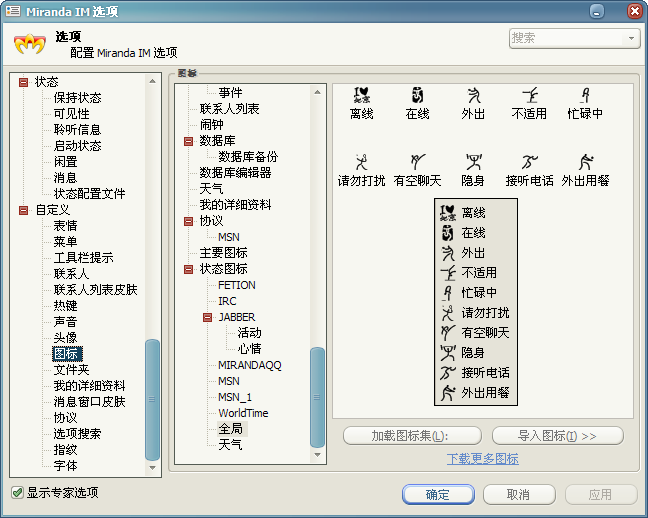
Description: 使用 Olympic Beijing Font 生成.
Chinese - English - Sporting Event - IM Status Dictionary:
http://lancaster.themex.net/archives/1275
Aztec Icons 1.0
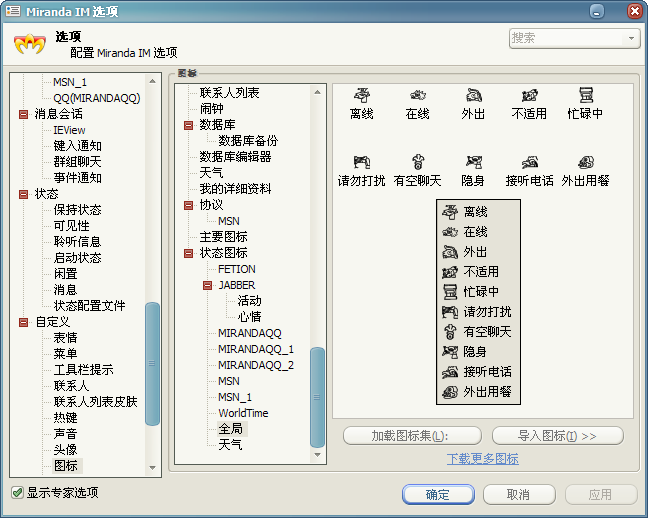
Description: 使用 Aztec font 生成.
Chinese - English - Aztec - IM Status:
http://lancaster.themex.net/archives/1265
阿茲特克(或譯為阿茲台克、阿茲提克)是一個在14世紀-16世紀的墨西哥古文明。
维基中文: http://zh.wikipedia.org/w/index.php?title=%E9%98%BF%E8%8C%B2%E7%89%B9%E5%85%8B%E6%96%87%E6%98%8E&variant=zh-tw
阿兹特克人在文字上的发展,没有玛雅人那样成熟,仍使用绘画文字。但他们在医学方面却有相当成就。他们知道许多草药的用途,如用洋地黄治心脏病,用奎宁治疟疾,还能用一种草药制作麻醉剂,这在当时是很先进的。
百科首页: http://baike.baidu.com/view/704855.htm
Aztec is a term used to refer to certain ethnic groups of central Mexico, particularly those groups who spoke the Nahuatl language and who achieved political and military dominance over large parts of Mesoamerica in the 14th, 15th and 16th centuries, a period referred to as the Late post-Classic period in Mesoamerican chronology.
Wikipedia EN: http://en.wikipedia.org/wiki/Aztec
唐韵 TangYun (金 Jin) Icons 1.0

Description: 使用中研院金文生成.
Chinese - English - Jin - IM Status Dictionary:
http://lancaster.themex.net/archives/1261
金文亦称“铭文”或“钟鼎文”,乃铸或刻于青铜器上的文字,承接甲骨文而起。初始于商末,盛于西周,记录的内容与当时社会,尤其是王公贵族的活动息息相关,多为祀典、赐命、征伐、围猎及契约之事。大部分人以周宣王在位时期铸造的毛公鼎[1]金文(又称西周金文)为代表,毛公鼎铭文共三十二行,四百九十七字[2]。
西周以降,金文被普遍地使用,而用途则无甚改变[3]。据统计,其文约有三千零五字,可辨识者,计有一千八百零四字,比甲骨文略多。由于商周盛行青铜器,而青铜礼器以“鼎”为代表,乐器以“钟”为代表,故刻于其上之金文,亦因而得“钟鼎文”之名。
维基中文: http://zh.wikipedia.org/w/index.php?title=%E9%87%91%E6%96%87&variant=zh-cn
Chinese Bronze inscriptions are writing in a variety of Chinese scripts on Chinese bronze artifacts such as zhōng[1] bells and dǐng tripodal cauldrons from the Shāng dynasty to the Zhōu dynasty and even later. Early bronze inscriptions were almost always cast (that is, the writing was done with a stylus in the wet clay of the piece-mold from which the bronze was then cast), while later inscriptions were often engraved after the bronze was cast.[2]
Wikipedia EN: http://en.wikipedia.org/wiki/Chinese_bronze_inscriptions
唐韵 TangYun (隶书 LiShu) Icons 1.0
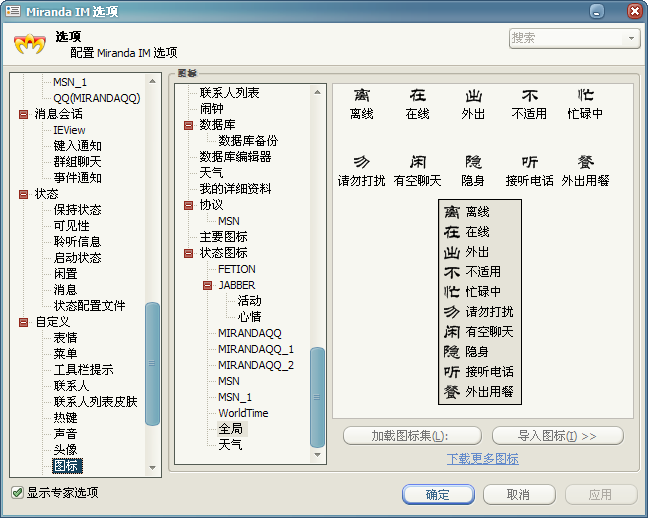
Description: 使用华文隶书生成.
Chinese - English - LiShu - IM Status Dictionary:
http://lancaster.themex.net/archives/1269
隶书是汉字中常见的一种庄重的字体,书写效果略微宽扁,横画长而直画短,讲究“蚕头雁尾”、“一波三折”。
隶书起源于秦朝,在东汉时期达到顶峰,书法界有“汉隶唐楷”之称。也有说法称隶书起源于战国时期。
维基中文: http://zh.wikipedia.org/w/index.php?title=%E9%9A%B6%E4%B9%A6&variant=zh-cn
The clerical script (traditional Chinese: 隸書; simplified Chinese: 隶书; pinyin: lìshū; Japanese: 隷書体, Reishotai;), formerly also chancery script, is an archaic style of Chinese calligraphy which evolved in the Warring States period to Qin dynasty, was dominant in the Han dynasty, and remained in use through the Wèi-Jìn (晉) periods.[1] Due to its high legibility to modern readers, is still used for artistic flavor in a variety of functional applications such as headlines, signboards and advertisements. This legibility stems from the highly rectilinear structure, a feature shared with modern regular script (kaishu), as well as from the fact that clerical is its nearest predecessor in time. In structure and rectilinearity it is generally similar to the modern script; however, in contrast with the tall to square modern script, it tends to be square to wide, and often has a pronounced, wavelike flaring of isolated major strokes, especially a dominant rightward or downward diagonal stroke. Some structures are also archaic.
Wikipedia EN: http://en.wikipedia.org/wiki/Clerical_script